Yesterday was my husband's surgery to have the catheter put in and I'm so thankful it is over and he is home with us. At every hospital, at every dialysis clinic, things are going to be different, so my story is just that.... my experience and it may be nothing like yours, but I'm sharing it because I know when Hubby was first diagnosed I looked and looked, but couldn't find anyone that told how it was for them, so I'm hoping this will help someone.
After surgery, while he was in recovery, the dialysis nurse came to speak with us. She was very organized and gave us a shopping list, a sheet of appointments for the next two weeks, and a binder of information. She brought the actual machine to show us and gave me a spec sheet so I could buy a cart.
Let's start with the shopping list. These are things that we need when doing PD.
Cart (this is to hold the machine and a discharge bucket so you can move around your home)
Bucket (at least 5 gallon)
Generator (big enough to run your dialysis machine when the power goes out)
Paper towels and wall mounting paper towel holder
Alcohol-based hand sanitizer
Antibacterial soap in pump dispenser
Sanitizer wipes
Bleach
There are items that we need that aren't included on this list, but where we go for dialysis, they supply the masks and other items. The dialysis supply company supplies all the solutions, tubing, and equipment.
The cart is a little tricky to find. I received a lot of suggestions, even from the hospital, but I wasn't able to easily find one. I finally settled on one I found online. The cart I ordered is - Choice Knocked Down Stainless Steel 2 Shelf Utility Cart - 33 3/4" x 21" x 37" I won't know for sure if we will really like it or not until it arrives, so I will do an updated post when we actually start using the cart.
Tomorrow the dialysis nurse is stopping by to make sure our home is ready for storing all the supplies and having the machine in a safe place. In preparation I'm moving furniture to make room for the cart to easily move around and to make space to store all the supplies. The large supplies are being stored in the living room and the smaller items are going in our bedroom on a small shelving unit. Friends of ours were generous to stop by today and drop of these items.
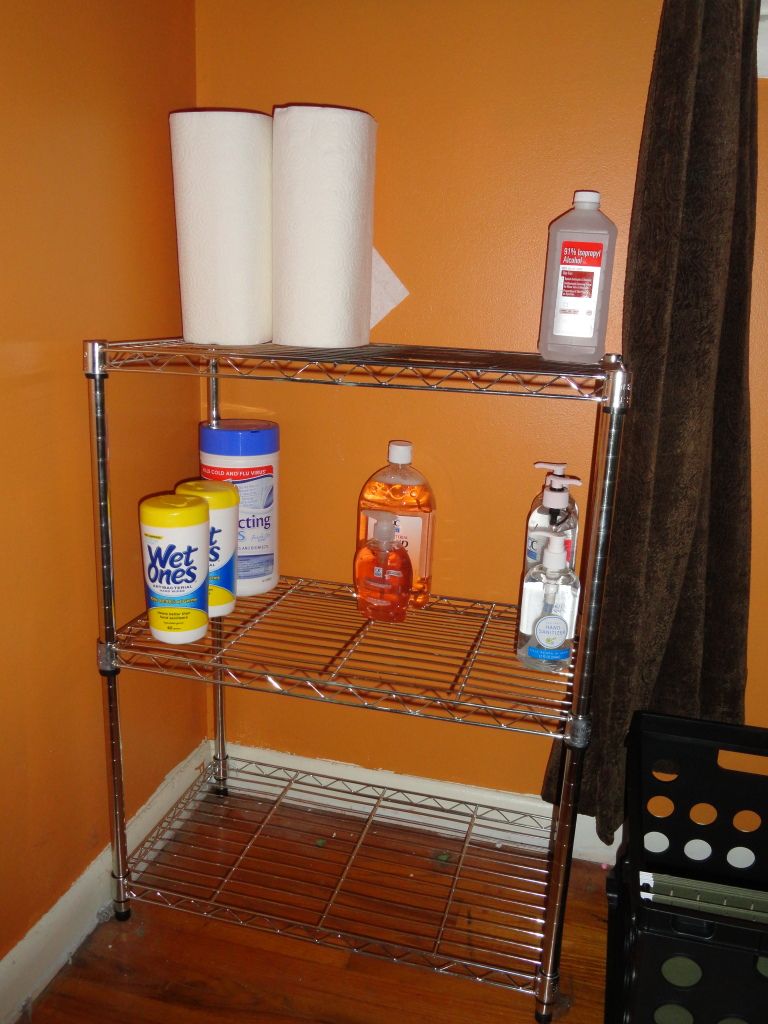
The black crate next to the shelving unit is a file box that holds all the dialysis information files that aren't in the binders. Behind the files is where I will be storing the binders when I'm not using them.
Remember all centers and hospitals are different, these may not be items that you need. Ask your provider for their suggestions too.
Thursday, May 24, 2012
Tuesday, May 22, 2012
God is Amazing!
Last night I sent out prayer requests to my local friends and through the power of prayer my husband's surgery has been rescheduled for tomorrow. The hospital said it is going to take a lot to coordinate everyone who needs to be there, doctors, nurses, and staff, but they said they are going to make it happen.
Hopefully one day I can get off this crazy emotional roller coaster ride.... I really don't like roller coasters :-)
Monday, May 21, 2012
Emotional let-down
I want this blog to be a true account of my experiences, it may not always be positive and I hope that is ok. Right now I need to let it all out. Tomorrow my husband was suppose to have his surgery. We just received a call from the transplant team that another patient is getting a transplant and my husband's catheter surgery has been canceled. We didn't even know there was a chance of it being canceled.
I'm thrilled that someone is getting a transplant. I'm praying everything goes beautifully for them tomorrow.
My heart, however is crying for us. Hubby feels horrible. His creatinine is at 7.2. Most days he barely eats and some days he is barely able to move. I don't know when they will be able to reschedule, because this doctor only does surgeries on Tuesdays, so that really limits when it can be rescheduled. He also only does 3 each Tuesday, so if there are already 3 scheduled for next Tuesday, he won't be able to get an appointment. I do have a call into the nurse to find out when we can reschedule this surgery.
Tears are streaming down my face and I feel physically sick. I didn't want my husband to have to go through surgery, but I knew this surgery would lead to him feeling better and now he has to wait.
This also has a great financial effect on us. For people who think disability benefits are great, let me tell you they aren't. It isn't even enough to pay for our home. We are currently selling anything we can in order to try and make some money. Our hope was that a month after hubby started dialysis (which would have started about 3 weeks after his surgery), he would have felt good enough to return to work. Pushing the surgery back a week or two or three, really hurts us because it will be that much longer before he can return to work. I work, but we were surviving on both our incomes and with him being sick I have missed some work. With the summer upon us I have also lost my income as a teacher.
The only thing that is keeping me going is the faith that God will provide. God is in control and He will guide us.
The tears will probably continue until I have a new appointment for him because I'm human, but we will be ok because God is always there.
I'm thrilled that someone is getting a transplant. I'm praying everything goes beautifully for them tomorrow.
My heart, however is crying for us. Hubby feels horrible. His creatinine is at 7.2. Most days he barely eats and some days he is barely able to move. I don't know when they will be able to reschedule, because this doctor only does surgeries on Tuesdays, so that really limits when it can be rescheduled. He also only does 3 each Tuesday, so if there are already 3 scheduled for next Tuesday, he won't be able to get an appointment. I do have a call into the nurse to find out when we can reschedule this surgery.
Tears are streaming down my face and I feel physically sick. I didn't want my husband to have to go through surgery, but I knew this surgery would lead to him feeling better and now he has to wait.
This also has a great financial effect on us. For people who think disability benefits are great, let me tell you they aren't. It isn't even enough to pay for our home. We are currently selling anything we can in order to try and make some money. Our hope was that a month after hubby started dialysis (which would have started about 3 weeks after his surgery), he would have felt good enough to return to work. Pushing the surgery back a week or two or three, really hurts us because it will be that much longer before he can return to work. I work, but we were surviving on both our incomes and with him being sick I have missed some work. With the summer upon us I have also lost my income as a teacher.
The only thing that is keeping me going is the faith that God will provide. God is in control and He will guide us.
The tears will probably continue until I have a new appointment for him because I'm human, but we will be ok because God is always there.
Hidden or forgotten additional costs
When someone we love gets sick, we realize that there will be extra expenses, but sometimes we don't realize how much extra there will be. When you are on a fixed budget and barely making it, going on disability or having to take time off of work can really hurt financially.
When planning your budget, keep these hidden or forgotten costs in mind.
- Gas to and from appointments. When hubby first started seeing doctors about his kidneys we had an 8 hour round trip and the gas costs really added up. Our trip is shorter now, but there is still additional fuel costs that need to be budgeted in. Sometimes we have 4 or 5 appointments a week, requiring me to full my tank multiple times a week.
- Co-Pays. Each appointment comes with a co-pay and when you go from visiting a doctor once a month to 4 times a week, the cost can go up by the hundreds.
- New or changing medications. As your loved one continues to have their health decline, it will undoubtedly mean new medications, dose changes, or additional treatments or herbal supplements, all which cost extra.
- Medical tests. Just like medication changes, as your loved one continues to have health issues, it may require more medical tests and care.
- Food. If you are traveling for the appointments, you will end up eating more convenience types of food, which will add cost to your weekly food budget. A good way to combat this is to plan ahead and pack a cooler.
- Loss of work hours. Not only may your loved one lose pay because of their health, but the family care provider, you, could also lose pay because of reducing your hours or giving up your job to take care of your loved one.
These hidden or forgotten additional costs can easily add up to thousands of dollars a month, which can be very difficult on a family already struggling. I haven't come up with a solution, other than to plan ahead, budget where you can, and pray.... I pray a lot.
When planning your budget, keep these hidden or forgotten costs in mind.
- Gas to and from appointments. When hubby first started seeing doctors about his kidneys we had an 8 hour round trip and the gas costs really added up. Our trip is shorter now, but there is still additional fuel costs that need to be budgeted in. Sometimes we have 4 or 5 appointments a week, requiring me to full my tank multiple times a week.
- Co-Pays. Each appointment comes with a co-pay and when you go from visiting a doctor once a month to 4 times a week, the cost can go up by the hundreds.
- New or changing medications. As your loved one continues to have their health decline, it will undoubtedly mean new medications, dose changes, or additional treatments or herbal supplements, all which cost extra.
- Medical tests. Just like medication changes, as your loved one continues to have health issues, it may require more medical tests and care.
- Food. If you are traveling for the appointments, you will end up eating more convenience types of food, which will add cost to your weekly food budget. A good way to combat this is to plan ahead and pack a cooler.
- Loss of work hours. Not only may your loved one lose pay because of their health, but the family care provider, you, could also lose pay because of reducing your hours or giving up your job to take care of your loved one.
These hidden or forgotten additional costs can easily add up to thousands of dollars a month, which can be very difficult on a family already struggling. I haven't come up with a solution, other than to plan ahead, budget where you can, and pray.... I pray a lot.
Sunday, May 20, 2012
Doctor Visit "Worksheet"
Appointments can be overwhelming. It is good to take someone who cares about you with you to help you remember and ask questions. It is sometimes hard not to feel rushed at an appointment, but remember the care provider is there for you and you ask any question you need to and keep asking until you are satisfied.
In your kidney or other health binder, you can just use plain loose leaf paper for your notes, but if it helps, I created a worksheet to print out and take to each appointment in your binder. It contains the basics at the top... date, weight, blood pressure, careprovider's name. Then there is a place for notes and at the bottom are some questions that I try to remember at each visit to ask. There is also space to put questions you want to ask at the appointment.
Did you think of something I forgot to add? Let me know and I will continue to post updated worksheets as I come up with and you provide ways to improve it!
Print the PDF file here.
In your kidney or other health binder, you can just use plain loose leaf paper for your notes, but if it helps, I created a worksheet to print out and take to each appointment in your binder. It contains the basics at the top... date, weight, blood pressure, careprovider's name. Then there is a place for notes and at the bottom are some questions that I try to remember at each visit to ask. There is also space to put questions you want to ask at the appointment.
Did you think of something I forgot to add? Let me know and I will continue to post updated worksheets as I come up with and you provide ways to improve it!
Print the PDF file here.
Types of Dialysis
Shortly after the nephrologist decided it was time to start dialysis, hubby and I went to a class on different types of dialysis. We had gone to the class with the decision that hubby was going to do In-center Hemodialysis. After hearing about the three options...
In-center Hemodialysis
At-home Hemodialysis
Peritoneal Dialysis
we decided to go with Peritoneal Dialysis. Peritoneal Dialysis, also called PD, is done at home every day. Why did we change our minds? One big reason. The port that is placed for hemodialysis can never be removed, even after transplant. Hubby is only 34 years old, I didn't want him to have restrictions on his left arm for the rest of his life because of a port. With PD they will insert a catheter into his abdomen and once he has had a successful transplant, it will be removed. Other advantages we learned about PD, it helps maintain what function your kidneys have left and because it is every day it is more like your natural kidney function. When the weather is bad and you don't want to venture out, PD is an easier option than driving to a center. Even if you lose power, you can still do PD. There are some disadvantages, the long hours (between 8 and 12 hours a day to do PD), the storing of all the supplies, and rearranging your home to allow for the equipment to move around easily. Overall we feel the advantages far outweigh the disadvantages. The biggest advantage? He gets to be home with us and spend time with his children, something he can't do at a center.
Picture courtesy of the Mayo Clinic
*Disclaimer - I am not a doctor, nurse, or any type of healthcare provider. I'm a wife who wants to share her experiences to help others. Everything I share is my opinion and experience, NOT advice or suggestions for you and your loved ones. Speak with your healthcare providers about all decisions and choices you make, so that they are right for you.
In-center Hemodialysis
At-home Hemodialysis
Peritoneal Dialysis
we decided to go with Peritoneal Dialysis. Peritoneal Dialysis, also called PD, is done at home every day. Why did we change our minds? One big reason. The port that is placed for hemodialysis can never be removed, even after transplant. Hubby is only 34 years old, I didn't want him to have restrictions on his left arm for the rest of his life because of a port. With PD they will insert a catheter into his abdomen and once he has had a successful transplant, it will be removed. Other advantages we learned about PD, it helps maintain what function your kidneys have left and because it is every day it is more like your natural kidney function. When the weather is bad and you don't want to venture out, PD is an easier option than driving to a center. Even if you lose power, you can still do PD. There are some disadvantages, the long hours (between 8 and 12 hours a day to do PD), the storing of all the supplies, and rearranging your home to allow for the equipment to move around easily. Overall we feel the advantages far outweigh the disadvantages. The biggest advantage? He gets to be home with us and spend time with his children, something he can't do at a center.
*Disclaimer - I am not a doctor, nurse, or any type of healthcare provider. I'm a wife who wants to share her experiences to help others. Everything I share is my opinion and experience, NOT advice or suggestions for you and your loved ones. Speak with your healthcare providers about all decisions and choices you make, so that they are right for you.
Friday, May 18, 2012
Kidney Binder or binder for any chronic illness
I created a "kidney binder" that I carry with me to all of hubby's appointments. I have found it really comes in handy, like today when the Dr didn't have the current blood work and I was able to pull it out of my binder and allow them to copy it. Saved hubby from having to get more blood drawn today and saved us money since getting blood drawn at the hospital costs us more.
What do I keep in the binder?
When I open my binder there is a manilla page divider. It is labeled "notes" and written on it are important phone numbers, like the doctor, the social worker, the dialysis nurse, the insurance company, and all the current medicines my husband is taking. Every appointment we have had, they have asked about medication, so it is really important to have that in an easy to find place.
Next is a bunch of loose leaf paper where I take notes. At every appointment I start a new page and write the date, who we saw, his weight and blood pressure, and almost everything we are told at the visit. It is great to have as a reference.
The next page divider is labeled "test orders". This is where I keep future blood work slips and other medical order slips. Hubby was part of a test study and we were given 4 months of blood work slips on one day, they were stored here and easily found when needed.
The next tab is labeled "information". This is where I keep sheets that we were given with information. One sheet is on a medicine that hubby was going to start taking, another is on PD dialysis (peritoneal dialysis), and any other information sheets we are given will go in that section.
Next is "appointments". This eventually can be cleaned out, but every time hubby has an appointment we are sent a reminder sheet in the mail, I put them all in here so we can reference them if we are unsure about an appointment time. There are lots of appointments, with a lot of different people and departments. It can become very overwhelming, so this does help, even if just a little.
The final section I have labeled is "blood work". Hubby always requests a copy be sent to our home, so we have all the blood work from the last few years. This really comes in handy!
Finally there is a section I haven't labeled yet. It will be labeled, "consent forms". As we are preparing for his surgery, he has been asked to sign a lot of papers. We have started asking for copies of everything he signs. Sadly today we were a little overwhelmed and forgot to get copies. I will call them Monday and ask that they send us copies. This is really important to try and remember, but it is totally understandable when it is forgotten.
Something I haven't done, but now see the need for is to make a checklist for every appointment and include asking for copies on there! When I create my checklist I will share it here in case you would like to print it out and use it.
What do I keep in the binder?
When I open my binder there is a manilla page divider. It is labeled "notes" and written on it are important phone numbers, like the doctor, the social worker, the dialysis nurse, the insurance company, and all the current medicines my husband is taking. Every appointment we have had, they have asked about medication, so it is really important to have that in an easy to find place.
Next is a bunch of loose leaf paper where I take notes. At every appointment I start a new page and write the date, who we saw, his weight and blood pressure, and almost everything we are told at the visit. It is great to have as a reference.
The next page divider is labeled "test orders". This is where I keep future blood work slips and other medical order slips. Hubby was part of a test study and we were given 4 months of blood work slips on one day, they were stored here and easily found when needed.
The next tab is labeled "information". This is where I keep sheets that we were given with information. One sheet is on a medicine that hubby was going to start taking, another is on PD dialysis (peritoneal dialysis), and any other information sheets we are given will go in that section.
Next is "appointments". This eventually can be cleaned out, but every time hubby has an appointment we are sent a reminder sheet in the mail, I put them all in here so we can reference them if we are unsure about an appointment time. There are lots of appointments, with a lot of different people and departments. It can become very overwhelming, so this does help, even if just a little.
The final section I have labeled is "blood work". Hubby always requests a copy be sent to our home, so we have all the blood work from the last few years. This really comes in handy!
Finally there is a section I haven't labeled yet. It will be labeled, "consent forms". As we are preparing for his surgery, he has been asked to sign a lot of papers. We have started asking for copies of everything he signs. Sadly today we were a little overwhelmed and forgot to get copies. I will call them Monday and ask that they send us copies. This is really important to try and remember, but it is totally understandable when it is forgotten.
Something I haven't done, but now see the need for is to make a checklist for every appointment and include asking for copies on there! When I create my checklist I will share it here in case you would like to print it out and use it.
Subscribe to:
Posts (Atom)

